
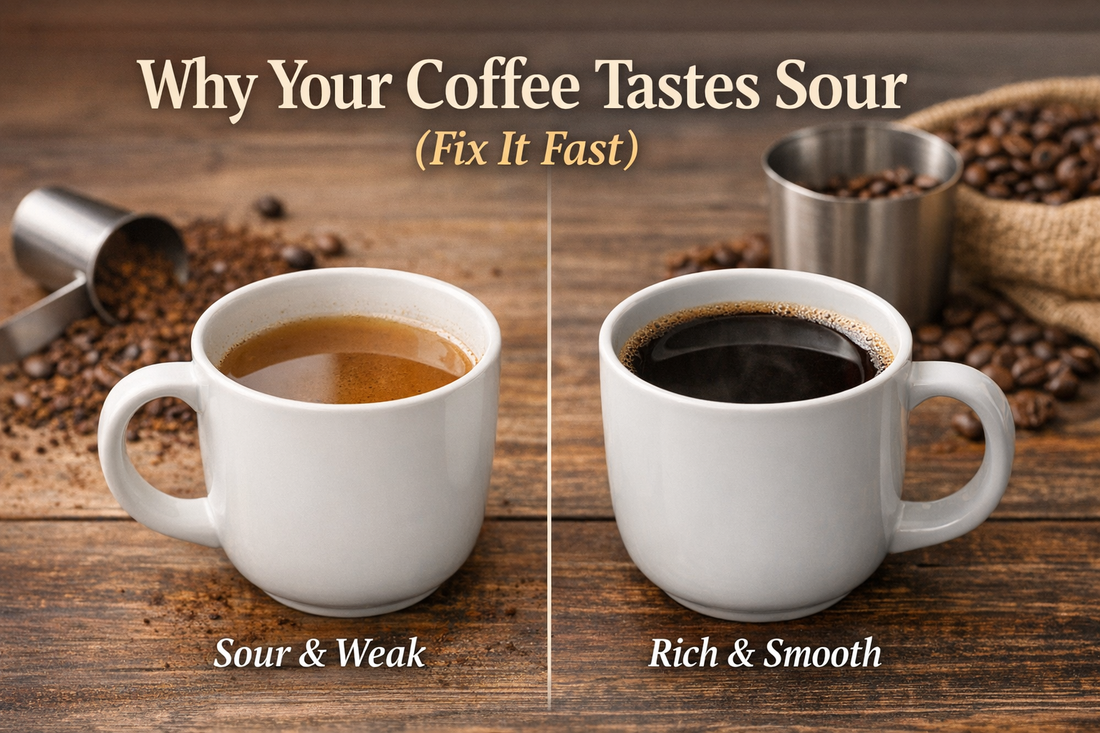
Why Your Coffee Tastes Sour (And How to Fix It)
If your coffee tastes sour, sharp, or even a little like lemon, you didn’t mess up your beans—you just need to adjust how you’re brewing.
Sour coffee almost always means it’s under-extracted. That simply means the water didn’t pull enough flavor out of the grounds. The fastest fix is to use slightly hotter water, grind a bit finer, or let it brew a little longer.
Once you make those small changes, your coffee can go from sour to smooth in a single cup.
The fastest way to fix sour coffee
Before you change anything complicated, try this on your next brew.
Use hotter water. Coffee extracts best just off boiling, around 195–205°F. If your water is too cool, it won’t fully develop the flavor.
Grind your coffee a little finer. A coarse grind lets water pass through too quickly, which leads to that sour, under-extracted taste.
Give it a little more time. A slightly longer brew helps balance the cup and brings out more of the deeper flavors.
Use a bit more coffee if needed. If your ratio is too low, the coffee can taste thin and sour at the same time.
These are small adjustments, but they make a big difference immediately.
What’s actually causing that sour taste
Coffee naturally contains acids, and when everything is balanced, those acids taste bright and pleasant. You might even notice subtle fruit or chocolate notes depending on the beans.
But when coffee is under-extracted, those acids take over the cup. That’s when it starts to taste sharp, hollow, or just off.
This usually happens when the grind is too coarse, the water isn’t hot enough, the brew time is too short, or the ratio is off. In other words, the coffee didn’t have enough time or contact to fully develop.
Once you correct that balance, the flavor smooths out quickly.
Sour vs acidic coffee (this part matters)
Not all acidity is bad, and this is where a lot of people get confused.
Good coffee often has a clean, bright acidity that makes it taste lively and interesting. That’s especially true with higher quality beans.
Sour coffee feels different. It’s sharp, unbalanced, and usually lacks body. It doesn’t feel intentional—it feels like something went wrong.
The difference isn’t the coffee itself. It’s how it was brewed.
How brewing method plays a role
Different brewing methods can make sourness more noticeable if something is off.
Pour-over can turn sour if your grind is too coarse or your pour is too fast. French press can taste sour if it doesn’t steep long enough. Drip machines sometimes struggle if the water doesn’t get hot enough. Espresso often tastes sour when the shot runs too quickly, which usually points back to grind size.
The key is knowing that each method has a small adjustment point. Once you find it, the results become consistent.
How to keep your coffee balanced every time
Consistency is what turns good coffee into great coffee at home.
Start with a solid ratio. If you’re unsure, How Much Coffee Should You Use Per Cup? will help you dial that in.
Make sure your grind matches your brewing method. If you need a quick guide, How Do I Choose My Coffee Grind? breaks it down simply.
And if your coffee still isn’t tasting right, How to Make Coffee Taste Better at Home ties everything together and helps you troubleshoot step by step.
When those three pieces—ratio, grind, and method—line up, the sourness disappears and the flavor finally makes sense.
Frequently asked questions
Why does my coffee taste sour even when I follow directions?
Small changes in grind size, water temperature, or brew time can throw things off. Try adjusting one variable at a time until it balances out.
Can you fix sour coffee after it’s brewed?
Not really. Once it’s brewed, the flavor is set. The best fix is adjusting your next cup.
Does sour coffee mean bad beans?
No. Most of the time, it’s a brewing issue, not a quality issue.
Is light roast coffee supposed to taste sour?
Light roasts can have more acidity, but they shouldn’t taste unpleasant. If they do, it usually means the coffee is under-extracted.
Final thoughts
Sour coffee isn’t random—it’s feedback.
Your coffee is telling you it needs a little more time, a little more heat, or a little more contact to fully develop its flavor.
Once you understand that, everything changes. You stop guessing and start adjusting with confidence.
And when you start with fresh, properly roasted coffee, it becomes even easier to get it right.
That’s what we care about at Jones’N Java—helping you brew better coffee at home, one cup at a time.
And if you want to keep improving your coffee step by step, you can explore more guides inside our Coffee Education Center, where we break everything down in a simple, practical way.